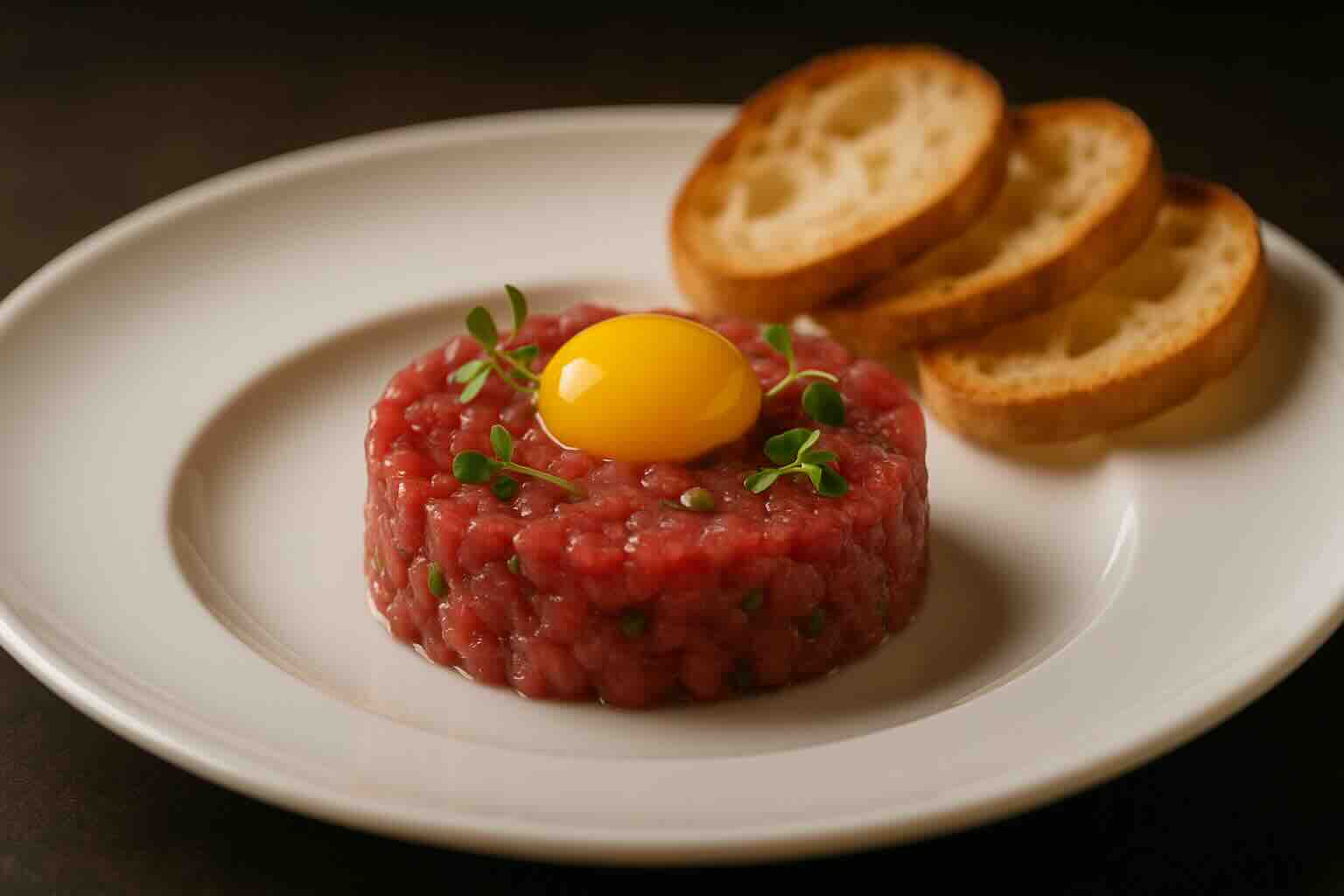
Almost everyone who has eaten a plate of seasoned raw beef has heard the story: nomadic Tatar horsemen tucked slabs of meat under their saddles, and the day's riding pounded the beef tender and ready to eat. It is a vivid image, and it gives the dish a romantic pedigree. It is also almost certainly not where the name comes from.
This article separates what we can reasonably say from what reads like later invention. The honest summary up front: the etymology of "tartare" is not fully settled, the dramatic origin story is best treated as folklore, and the most defensible explanation is a quieter, more recent one rooted in French restaurant cooking.
The famous story — and why to doubt it
The popular tale runs roughly like this: the Tatars (often conflated with the broader Mongol confederations of the 13th century) carried raw meat under their saddles to tenderize it, ate it raw out of necessity, and so lent their name to the dish. Variants add that European observers were horrified by the practice and that the word travelled back west with the story.
There are good reasons to treat this as likely apocryphal rather than as history:
- The saddle detail is physically implausible as a cooking method. Meat carried against a sweating horse for hours would be more plausibly used as a saddle pad or to treat the animal's sores — a use that does appear in some historical accounts — than prepared as cuisine. Turning that into "tenderizing tonight's dinner" looks like a later embellishment.
- The timeline does not line up. The dish we call steak tartare appears in the European culinary record only in the late 19th and early 20th centuries — many hundreds of years after the Tatar confederations of the medieval period. A name that genuinely descended from medieval nomads should leave a much longer paper trail than it does.
- The story is unsourced where it matters. It circulates widely in popular writing but is not anchored to a contemporary medieval account describing this specific food and this specific name. Repetition is not evidence.
None of this means the Tatar peoples are irrelevant to the broader history of eating raw or minced meat — many cultures have done so. The point is narrower: the saddle-tenderizing anecdote does not stand up as the documented source of the French dish's name.
The more plausible route: through the sauce
The explanation most food historians find more defensible is almost anticlimactic. In French cooking, dishes served "à la tartare" were associated with sauce tartare — a cold sauce based on mayonnaise with capers, herbs, mustard, and chopped pickle or onion. Early menu and cookbook references to beefsteak "à la tartare" describe a steak (sometimes raw, sometimes lightly cooked) served with, or in the style of, that sauce, or with the seasonings the sauce implies.
Over time the phrase contracted. "Steak à la tartare" became "steak tartare," and the seasonings — capers, mustard, onion, sometimes a raw yolk — migrated into the meat itself rather than sitting alongside it as a separate sauce. On this account, the dish is named for a French sauce and serving style, not for a band of horsemen.
There is a related thread worth knowing. Early French references also describe steak à l'américaine: raw or barely cooked minced beef bound with raw egg yolk. Some scholars argue that what we now call steak tartare evolved from, or was a variant of, this "américaine" preparation, with the "tartare" label originally pointing to the accompanying sauce and only later attaching to the whole dish. The exact relationship between the two terms is genuinely murky.
So why is tartar sauce called that?
If the dish is named after the sauce, the obvious next question is why the sauce is called tartare. Here too the honest answer is that it is uncertain. The most common suggestion is that "tartare" was simply a fashionable, exotic-sounding culinary adjective in 19th-century French kitchens — the same impulse that produced names like "à la russe" or "à la turque" — rather than a literal claim about Tatar cuisine. The capers-and-pickle profile of the sauce has no documented connection to any Tatar food tradition.
In other words, the chain may run: a fashionable sauce name → a steak served in that style → a contracted dish name. The "Tatar" reference, if it exists at all, is decorative branding, not culinary descent.
The short version: "Tartare" most plausibly reached the plate through French sauce tartare and the late-19th-century habit of serving seasoned raw or near-raw beef "à la tartare." The horsemen are a good story, not a documented source.
How "tartare" became a category
Once "steak tartare" was established on French menus in the early 20th century, the word did something useful: it generalized. "Tartare" stopped meaning only "seasoned raw beef" and came to describe a technique and presentation — finely diced or minced raw (or sometimes cured/cooked) ingredients, seasoned and bound, served cold, often molded into a neat round.
That is why you now see tuna tartare, salmon tartare, scallop tartare, and entirely meat-free versions like beet or tomato tartare. None of these have anything to do with Tatars or even with the original sauce; they borrow the format. If you want to see how far the category now stretches, our overview of the different styles is a good map.
What we can responsibly say
- The Tatar-saddle origin story is likely apocryphal and should not be repeated as fact.
- The better-supported explanation runs through French sauce tartare and dishes served "à la tartare," with a likely connection to steak à l'américaine.
- The precise etymology of the sauce's own name is uncertain; "tartare" was probably an evocative culinary label rather than a literal ethnic reference.
- "Tartare" today is best understood as a culinary category — diced, seasoned, served cold — far broader than the original beef dish.
If a single takeaway helps: a tidy, confident origin story is usually a sign that the real history has been smoothed over. Where the evidence is thin, the more useful answer is to say so.