If you have ever stood at a fish counter looking for something to dice into tartare or slice for a crudo, you have probably seen the words "sushi-grade" or "sashimi-grade" on a label or heard them from a fishmonger. They sound like a guarantee. They mostly are not.
This article explains what these terms actually mean, what they tend to imply in practice, and — more usefully — how to judge whether a piece of fish is a sensible candidate for eating raw. The food-safety authority where you live always takes precedence over anything here; treat our specific suggestions as editorial guidance, not regulation.
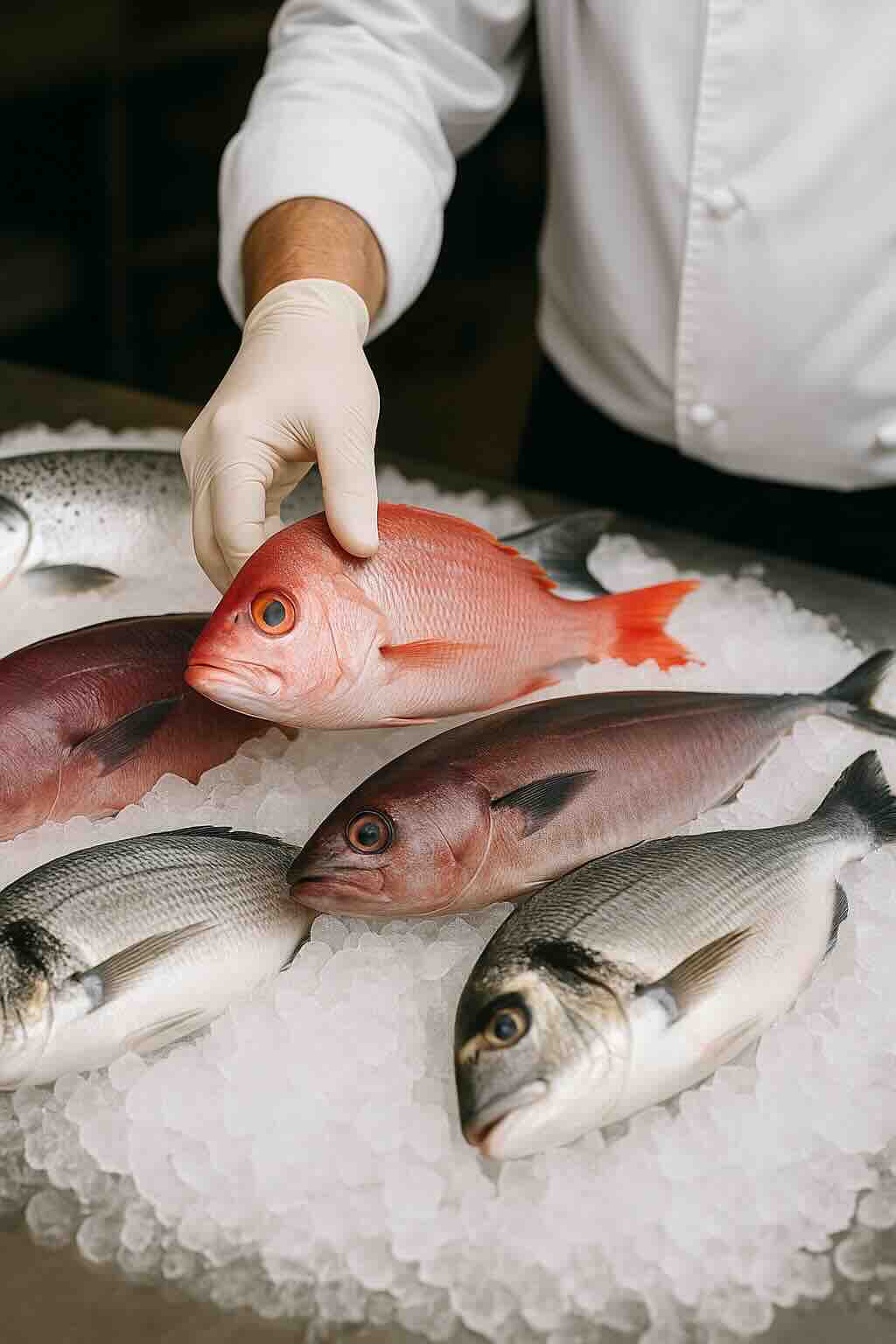
The uncomfortable truth: the terms are not regulated
In most countries, including the United States, "sushi-grade" and "sashimi-grade" are not legally defined and not independently certified. No government agency issues a grade, no inspector stamps the fillet, and there is no standard a seller has to meet before using the words. They are marketing language. A shop can put "sushi-grade" on a tray because it believes the fish is suitable for raw consumption, and a shop down the street can decline to use the term for fish handled the same way.
That does not make the words meaningless. A reputable seller uses them to signal that the fish was handled with raw consumption in mind: caught, bled, chilled, and stored carefully, and — where relevant — frozen to a standard intended to destroy parasites. But the term is only as trustworthy as the person saying it, which is why the relationship with your fishmonger matters more than the label.
Short answer: fish is "sushi grade" when the seller judges it fit to eat raw. In practice that means it is very fresh, was handled cold and clean from boat to counter, and, for species that can carry parasites, was frozen to a parasite-kill standard such as the FDA's −20°C (−4°F) for 7 days. No government inspector awards the grade. It is the seller's claim, and it is worth as much as the seller.
What makes fish sushi grade?
Because nobody certifies it, "sushi grade" is really a list of conditions a careful supplier tries to meet. The fish is considered sushi grade when all of these hold:
- The right species. Some fish are routinely eaten raw (tuna, farmed Atlantic salmon, yellowtail/hamachi, scallops, sea bream); others are almost never sold for raw use because of parasite or texture problems, such as wild freshwater fish, cod and many wild Pacific salmon unless frozen. See the best fish for tartare.
- Handling at catch. Good raw-use fish is typically killed quickly, bled, gutted soon after, and chilled hard on ice or in slurry. Bleeding and fast chilling slow spoilage and keep the flesh clean-tasting. In Japan the ikejime method (a fast spike to the brain, often followed by destroying the spinal cord) is prized for exactly this reason.
- Parasite control. Species that can carry parasites such as Anisakis are frozen to a defined time and temperature before being sold for raw consumption, unless they are an exempt species (most notably certain tunas) or farmed under conditions that control the risk. The FDA figures are below.
- An unbroken cold chain. From boat to processor to shop to your fridge, the fish stays close to 0°C (32°F). Bacteria are the main risk this controls, and freezing does not fix a warm-handled fish.
- Sensory quality. Firm, glossy, translucent flesh, bright colour, and a clean sea smell. Raw fish has nowhere to hide, so the best-looking pieces are the ones set aside for raw use.
If a seller cannot tell you how at least the first four were handled, the words on the label are not doing much.
What does sashimi grade mean?
"Sashimi grade" means the same thing as sushi grade: the seller says the fish is fit to be eaten raw. Some shops reserve it for their very best pieces, because sashimi is plain slices with no rice, sauce or seasoning to hide flaws, so appearance and texture matter more. But there is no rule making sashimi grade stricter than sushi grade, and you should not assume a safety difference between the two phrases.
If you are translating (people search for "sashimi grade 意思", meaning "what does sashimi grade mean"): Japanese shops do not really use a "grade". Labels in Japan usually say 刺身用 (sashimi-yō, "for sashimi", i.e. may be eaten raw) versus 加熱用 (kanetsu-yō, "for cooking"). That is closer to what the English terms are trying to say than any grading system. A "sashimi grade sushi" menu line simply means the kitchen is claiming the same raw-quality fish for both.
What the terms tend to imply in practice
Although there is no official standard, "sushi-grade" and "sashimi-grade" are used fairly consistently by careful sellers to mean some combination of the following:
- Handled for raw use from the start. Fish destined to be eaten raw is ideally bled and chilled quickly after catch, kept very cold, and protected from cross-contamination.
- Parasite-control freezing where applicable. For species that may carry parasites, food-safety guidance calls for freezing under specific time-and-temperature conditions before the fish is sold for raw consumption (more on this below).
- Higher quality and freshness. The fish is selected for appearance, firmness, and smell, since those qualities are exposed when the fish is not cooked.
In everyday use the two phrases are essentially interchangeable. "Sashimi-grade" sometimes implies an even higher visual standard, because sashimi is served as clean slices with no seasoning to hide behind, but there is no rule enforcing that distinction. Do not read a meaningful safety difference into one word versus the other.
The freezing question (and why tuna is often different)
The most important thing these labels can imply is whether the fish has been frozen to kill parasites. In the United States, the FDA's Fish and Fishery Products Hazards and Controls Guidance (and the Food Code) gives three freezing options for fish that will be eaten raw:
| Option | Freeze | Then hold |
|---|---|---|
| 1 | At −20°C (−4°F) or below | For 7 days total (at −20°C or below) |
| 2 | At −35°C (−31°F) or below until solid | At −35°C (−31°F) or below for 15 hours |
| 3 | At −35°C (−31°F) or below until solid | At −20°C (−4°F) or below for 24 hours |
A home freezer usually runs around −18°C (0°F), which is warmer than option 1, and it cannot reach option 2 or 3 at all. That is why commercially frozen fish from a trusted supplier is the safer route than freezing fish yourself. In the EU, the equivalent rule is −20°C for at least 24 hours or −35°C for at least 15 hours. Rules and exemptions differ by country, so check with your local food-safety authority. The full detail, including which parasites this covers, is in does freezing kill parasites in fish?
Freezing kills parasites. It does not kill most bacteria and it does not undo poor handling, so a frozen fish still needs a clean, cold history.
Certain tuna species are commonly exempted from parasite-destruction freezing requirements, because they are considered to pose a negligible parasite risk for that hazard. This is one reason tuna is so often sold and served raw without having been frozen first. It is also why "sushi-grade tuna" and, say, "sushi-grade salmon" are not telling you the same story: the salmon should typically have been frozen for parasite control, while the tuna may legitimately never have been.
Bottom line on freezing: for most non-tuna species you want raw, the relevant question is not "is it sushi-grade?" but "has this been frozen to the parasite-control standard, or is it exempt?" Ask directly. For a deeper treatment see our article on whether freezing kills parasites in fish.
How is tuna actually graded?
Tuna is the one fish where a real grading culture exists. It is still a trade practice run by experienced buyers, though, not a government standard. At the big Japanese markets, above all Tokyo's Toyosu (which replaced Tsukiji in 2018), whole tuna are laid out before the morning auction. Buyers inspect each fish and judge it on a handful of signs:
- The tail cut. The tail is cut off to show a cross-section of the flesh. Buyers look at it closely, often with a flashlight, and may rub a little of the meat between their fingers. That cut tells them the colour, how the fat runs through the flesh, and how firm it is.
- Colour. They want a clear, deep red with a translucent sheen. Brown, dull or rainbow-sheened flesh suggests age or poor handling. With frozen tuna, buyers also look for signs that it was frozen well at ultra-low temperatures.
- Fat. How much fat there is and where it sits decides how much toro (the fatty belly) the fish will give, and fat is where most of the price comes from.
- Shape, size and handling. A plump, undamaged body, proper bleeding, and a history of fast chilling all count. So do the season and where the fish was caught.
The people doing this judging are not inspectors. They are licensed intermediate wholesalers known as nakaoroshi (仲卸, also called nakagai, "middle buyers"). They bid on the fish, break them down, and sell the cuts to restaurants and retailers. Many of them specialise in tuna for decades, and a good tuna buyer's eye is a respected skill. That is the closest thing to an answer to "what are the people who check if raw fish is good called". In the US, the tuna trade uses its own informal commercial scale, usually #1, #2+, #2 and #3, based on the same colour, fat and texture signs. Grading practices differ from market to market, so treat this as a general picture, not a formal specification.
None of this is a safety check. A top-grade bluefin is graded for eating quality. Handling and the cold chain are still what make it safe to eat raw.
Sushi-grade vs sashimi-grade vs regular fish
The table below summarises how these labels are typically used. Remember that none of the first two columns is a regulated category — the distinctions describe intent and handling, not a certification.
| Aspect | "Sushi-grade" | "Sashimi-grade" | Regular fish |
|---|---|---|---|
| Legally defined? | No (marketing term) | No (marketing term) | Sold for cooking |
| Implied intent | Suitable for raw use | Suitable for raw use; often top visual quality | Intended to be cooked |
| Parasite-control freezing | Expected where applicable (tuna often exempt) | Expected where applicable (tuna often exempt) | Not assured |
| Handling for raw eating | Yes, ideally cold-chain throughout | Yes, ideally cold-chain throughout | Not assured |
| Best raw use | Tartare, poke, sushi | Sashimi, crudo, tartare | Cook to a safe temperature |
How to actually judge fish for raw use
Because the label is unreliable on its own, build your confidence from the things you can verify:
- Source and turnover. A busy counter with high turnover and a knowledgeable staff is worth more than any word on a sticker. Provenance — where and how the fish was handled — matters more than appearance.
- Smell. Fresh fish smells clean, like the sea. A strong "fishy", sour, or ammonia note is a reason to walk away.
- Flesh and appearance. The flesh should look firm, moist, and glossy, not dull, dry, or gaping. Press gently if allowed; it should spring back.
- Cold chain. The fish should be cold to the touch, kept on or below ice, and not sitting in a pool of its own liquid.
For a fuller walkthrough, see our companion piece on how to tell if fish is safe to eat raw.
Questions to ask the fishmonger
The right questions get you far more than the label does. Try these:
- "Is this fish suitable for eating raw?" — and watch how confidently it is answered.
- "Has it been frozen to a parasite-control standard, or is this a species that is exempt?"
- "When did it come in, and how has it been stored?"
- "Can you cut me a fresh piece from the centre rather than the display edge?"
A good fishmonger welcomes these questions. Vagueness or irritation is itself an answer.
The practical takeaway
"Sushi-grade" and "sashimi-grade" are useful shorthand from a seller you trust, and nearly worthless from one you don't. They are not certifications. What actually keeps raw fish safe is careful sourcing, an unbroken cold chain, appropriate parasite-control freezing for species that need it, and your own honest assessment of smell and appearance. Buy from people who can answer your questions, and let the answers — not the sticker — decide.