Visitors to Germany often find it early in the trip, usually at a bakery counter or a hotel breakfast: a halved roll spread thickly with something pink, dusted with black pepper and piled with raw onion. That is a Mettbrötchen, and it is as ordinary in much of Germany as a ham sandwich is in Britain. Looking at the dish and at the rules behind it explains why raw pork works there and why the habit doesn't travel.
If you want the dish itself, including a safer beef version, see our Mett (German raw pork) recipe page. This article covers the background.
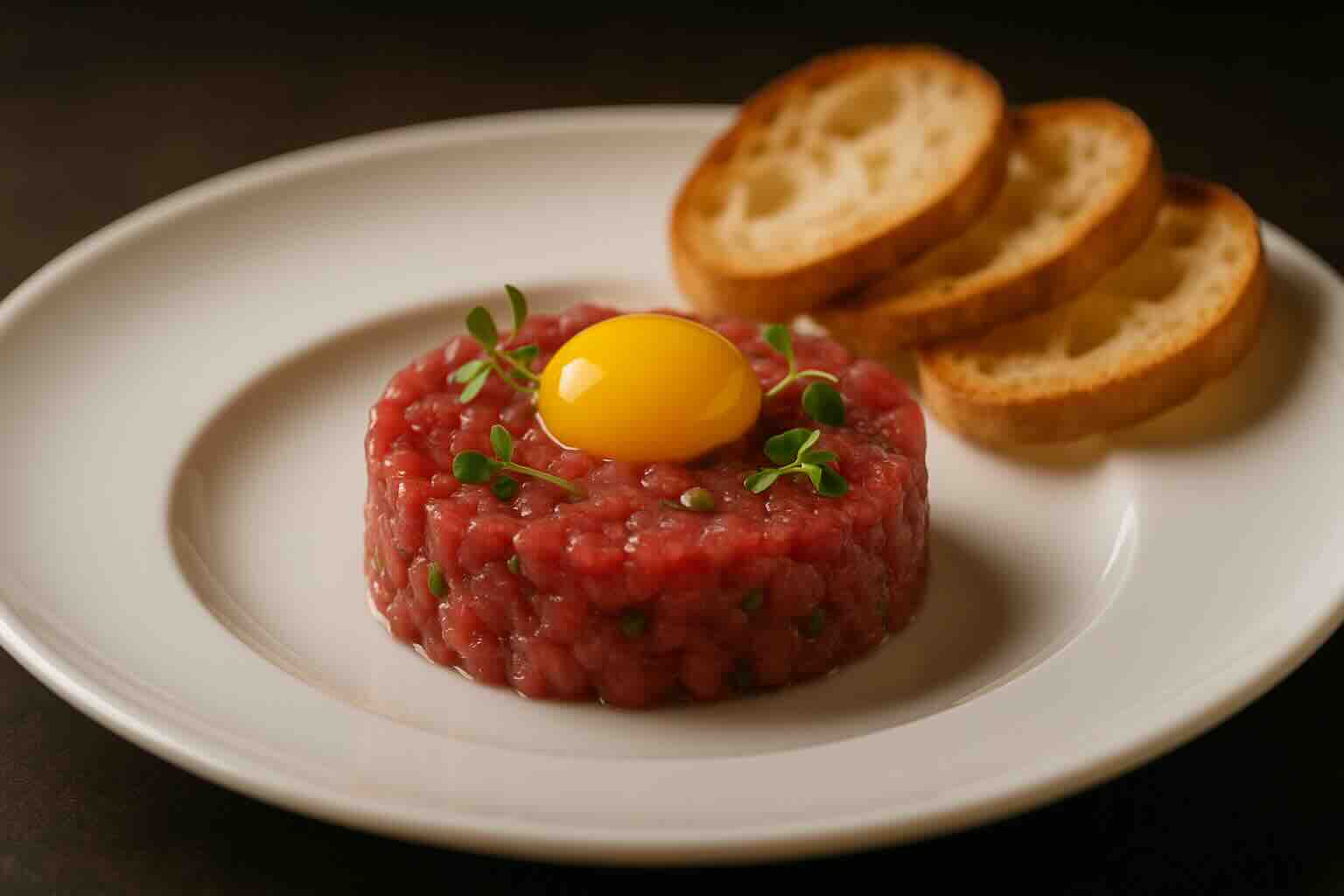
What is Mett? The raw pork dish in Germany
Mett is raw minced pork that has been seasoned, usually with salt and black pepper and sometimes with garlic, caraway or nutmeg depending on the region and the butcher. The word comes from Low German mett, meaning chopped pork without bacon. In Berlin and much of the north and east it is called Hackepeter. The unseasoned base is Schweinehackfleisch (minced pork), and Zwiebelmett has chopped onion already mixed in. German food-labelling guidelines (the Leitsätze für Fleisch und Fleischerzeugnisse) define what may be sold under these names, including limits on fat and connective tissue, so Mett from a butcher is a standardised product and not simply whatever was left over.
What is Mett made of? Pork, typically from shoulder and belly trimmings, coarsely minced with a moderate fat content so it spreads. It also has salt, pepper and, often, a little of the butcher's own spice mix. There is no curing, smoking or cooking. The texture is soft and slightly sticky, and the flavour is mild, savoury and peppery.
The German raw pork sandwich: Mettbrötchen
The usual way to eat it is the Mettbrötchen: a crusty white roll (Brötchen), halved, sometimes buttered, spread with a thick layer of Mett, seasoned with more pepper and topped with finely chopped raw onion or onion rings. This raw pork with onion is the German raw pork sandwich visitors ask about. It turns up at breakfast, at bakery counters, at butchers' snack bars and at the Mettbrötchen tables of football grounds and workplace canteens. Some people add a few chives, a pinch of salt or a little mustard.
The Mettigel: the German raw pork hedgehog
The Mettigel (“Mett hedgehog”) is party food. It is a mound of Mett shaped into an oval hedgehog, with half-rings or slivers of raw onion (or sometimes pretzel sticks) pushed in as spines, and peppercorns, olives or capers for eyes and nose. It sits on a board surrounded by rolls and guests spread their own. It is closely tied to the buffets of the 1960s and 70s and has come back as a retro or ironic favourite at birthdays and office parties.
Why can Germans eat raw pork?
Raw pork is not naturally safer in Germany. The meat goes through a supply chain that has been regulated with raw eating in mind for decades, and the product is sold so fresh that bacteria have little time to multiply.
From the Hackfleischverordnung to today's rules
For about thirty years West Germany, and then reunified Germany, had a dedicated regulation for minced meat, the Hackfleischverordnung (introduced in 1976). It set out how minced meat could be made, stored and sold, including strict same-day sale for many products and temperature limits. It was repealed in 2007 when the EU food hygiene package came into force. Its core ideas carried over into EU Regulation (EC) No 853/2004 and into Germany's national implementing rules for foods of animal origin (the Tierische Lebensmittel-Hygieneverordnung, Tier-LMHV). In broad terms, today's framework means:
- Cold chain. EU rules require minced meat to be kept at 2°C/36°F or below.
- Same-day sale. German rules generally require minced meat intended to be eaten raw, sold loose at the counter, to be sold on the day it is minced. Leftovers cannot be carried over to the next day as raw Mett.
- Restricted use. Raw minced meat products are expected to be eaten promptly. Official advice from the German Federal Institute for Risk Assessment (BfR) says vulnerable groups should not eat them at all.
- Hygiene standards. Producers who mince meat for raw consumption work under specific hygiene and microbiological requirements and are inspected by local food-control authorities.
The precise wording and exemptions have changed over the years, so treat the list above as an outline and not as legal text.
Trichinella inspection of pigs
The parasite most people associate with raw pork is Trichinella spiralis, the roundworm that causes trichinellosis. Germany started systematic microscopic “trichina inspection” of slaughtered pigs in the 19th century, after serious outbreaks. Today EU law (Regulation (EU) 2015/1375) requires Trichinella testing of pig carcasses, with limited exemptions for officially recognised controlled-housing farms. With indoor commercial farming and routine testing, the parasite is extremely rare in German commercial pork. The occasional human cases in Europe tend to be linked to wild boar or to meat from uninspected home slaughter, not to butcher's Mett.
Is Mett risk-free? No
This is where it's often oversold. Trichinella control handles one hazard. Several others remain, and they are the reason German health authorities still advise caution:
| Hazard | Why it matters for raw pork | Controlled by German rules? |
|---|---|---|
| Trichinella | Parasite in muscle; historically the main raw-pork danger. | Largely, via carcass testing and farm controls. |
| Salmonella | Common in pigs; mincing spreads surface bacteria through the whole batch. | Reduced by hygiene and cold-chain rules, not eliminated. |
| Yersinia enterocolitica | Pigs are a main reservoir; it can grow slowly even at fridge temperatures. | Reduced by same-day sale, not eliminated. |
| Hepatitis E virus | Found in pigs in Europe; raw and undercooked pork products are a recognised route of infection. | No; there is no routine carcass test. Only thorough heating reliably inactivates it. |
| Listeria, E. coli | General hazards of any raw minced meat. | Reduced by hygiene and cold chain. |
Raw minced pork appears regularly in German public-health reporting on salmonellosis and yersiniosis, and the BfR advises that pregnant people, young children, older adults and immunocompromised people should not eat raw minced meat, Mett included. The fair summary is that Germany has made raw pork lower-risk, not safe. Millions of Germans eat Mett without incident, and a small but real number get ill from it.
Mett vs raw ground pork from a supermarket
The two look the same, but the difference lies in how they are produced and sold. Mett is minced from fresh meat, specifically for raw eating, and sold that day at 2°C or below by a business inspected against those standards. Ordinary ground pork, in Germany or anywhere else, is produced to be cooked. It may be several days old by its use-by date, may have been minced from trimmings handled with cooking in mind, and nobody has promised anything about eating it raw. Supermarket ground pork is not Mett and should not be eaten raw. This applies in Germany as well: pre-packed minced pork is labelled for cooking unless the pack explicitly says it is suitable for raw consumption.
Is Mett (raw pork) available in the UK or US?
In practice, no. Neither country has a retail framework for selling minced pork to be eaten raw. UK Food Standards Agency advice is to cook pork, and especially minced pork, until it is steaming hot throughout with no pink left. US USDA guidance is to cook ground pork to 71°C/160°F. A German deli in London or a butcher in Wisconsin may sell Mettwurst, but that is a different product: a cured, often smoked sausage, sometimes spreadable (Streichmettwurst, Teewurst), whose salt, curing and fermentation change the risk profile. It is not fresh Mett, and it is still not suitable for pregnant people or other vulnerable groups.
Safer ways to get the Mett experience
- Use beef instead. Very fresh, whole-muscle beef from a trusted butcher, trimmed and minced or hand-cut just before serving, then seasoned like Mett with salt, pepper and raw onion on a roll. With whole-muscle beef the contamination sits mainly on the surface, which is why well-sourced beef tartare is a more defensible raw choice than minced pork. Keep it below 4°C/40°F and eat it the same day. Start from our classic beef tartare and read is beef tartare safe? first. Raw beef still carries risk, and the same vulnerable groups should avoid it.
- Cook the pork. Season minced pork exactly like Mett, with a little onion mixed in, and fry it as small patties (Frikadellen) until cooked through. Serve on a buttered roll with raw onion rings on top. You get the same flavour with none of the raw-pork risk.
- Try other raw-meat traditions made the classic way. Our pages on Polish tatar, carne cruda all'albese, the Wisconsin cannibal sandwich and kibbeh nayyeh cover raw beef and lamb dishes with their own sourcing rules.
For a wider look at how cultures eat raw meat, see types of tartare and tartare around the world. For the differences between raw, cured and cooked meats (useful for understanding Mett versus Mettwurst), read raw vs cured vs cooked.