If you have ordered steak tartare in France or Belgium, you may have been asked a question you did not expect: préparé ou pas ? It is not a trick. French bistros serve tartare in two ways, and the waiter wants to know whether the kitchen should season it or whether you would rather do it yourself. This guide explains both styles, where tableside preparation comes from, how the Belgian filet américain fits in, and the handful of words you need to order confidently.
What is prepared beef tartare?
Prepared beef tartare is tartare that has been fully seasoned before it reaches you. The cook folds the chopped beef through a dressing of Dijon mustard, egg yolk, Worcestershire, a little oil, and finely chopped shallot, capers, cornichons and parsley, checks the salt, and shapes it into a disc, often with a ring mold. On a French menu you will see tartare de bœuf préparé, or simply tartare: in most modern bistros prepared is the default.
The advantage is consistency. The kitchen knows its own balance of acid and salt, the seasoning is evenly distributed, and the beef is mixed at the last moment so it stays red. The disadvantage is that you get the chef’s idea of heat and sharpness, not yours. Our classic beef tartare recipe is a prepared tartare in this sense.
What is unprepared beef tartare?
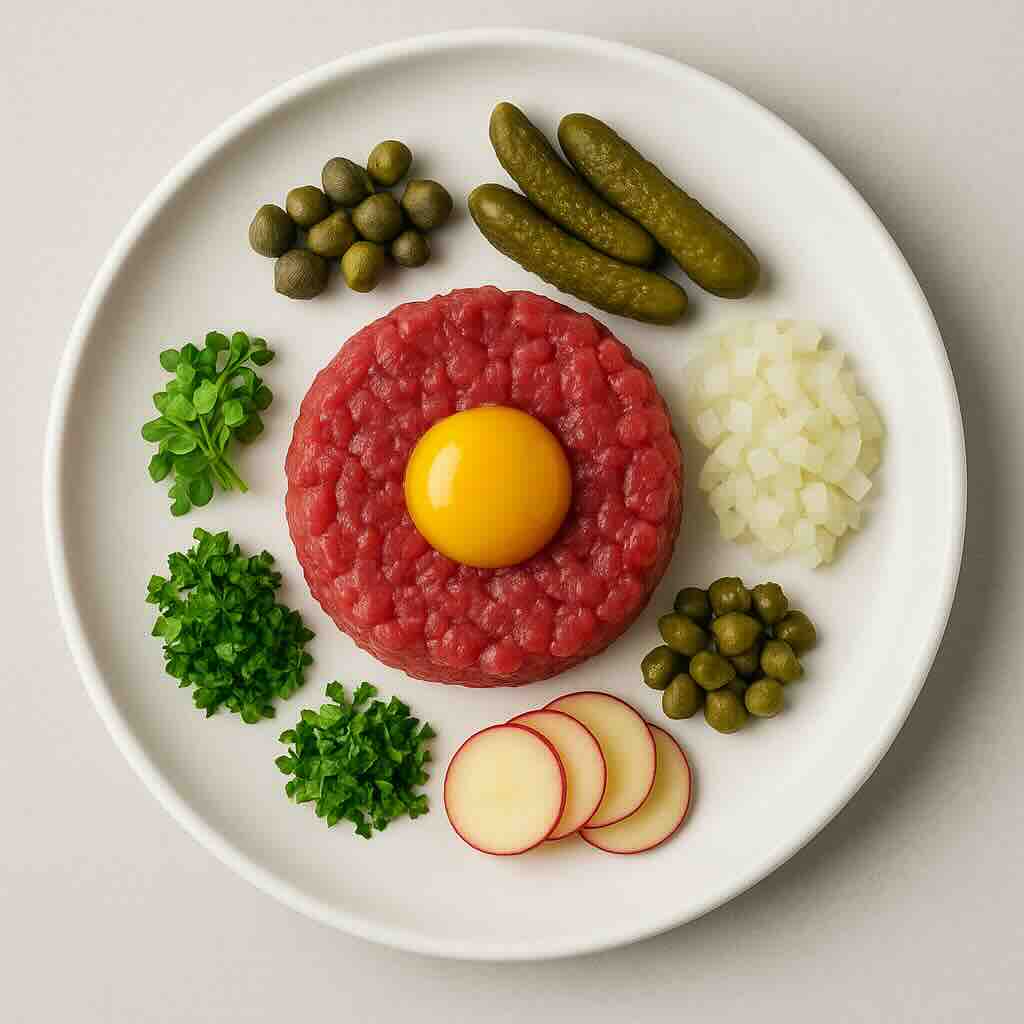
Unprepared tartare (tartare non préparé, tartare à préparer soi-même, sometimes tartare nature) is the older, more theatrical style. The plate carries a mound of plain, unseasoned chopped beef, usually with a well pressed into the top holding a raw egg yolk — sometimes still cradled in half its shell. Arranged around it: chopped shallot or onion, capers, cornichons, parsley, and often a pot of mustard, with Worcestershire, Tabasco, ketchup, oil, salt and pepper brought to the table.
You then mix it yourself on the plate, a little at a time, tasting as you go. It is slower, messier and more personal: you decide how much mustard, whether to add Tabasco, and whether the shallot goes in at all. Some diners like the contrast of eating the beef only lightly dressed with the garnishes taken bite by bite.
Prepared vs unprepared: side-by-side comparison
| Prepared (préparé) | Unprepared (non préparé) | |
|---|---|---|
| Who seasons it | The kitchen | You, at the table |
| How it looks | A smooth, uniform disc or quenelle, sometimes topped with a yolk | Plain red beef with garnishes in separate piles; yolk often in its shell |
| Seasoning balance | The chef’s, evenly mixed | Your own; can vary bite to bite |
| Texture | Softer, the dressing coats every cube | Firmer and cleaner if you mix lightly |
| Best for | First-timers, anyone who wants the classic balance | Regulars with firm preferences, people avoiding one ingredient |
| Typical menu words | tartare préparé, tartare de bœuf | non préparé, à préparer vous-même, nature |
Tableside preparation: how to make beef tartare on the spot
Between the two sits a third style that older brasseries and grand hotel dining rooms still keep: tartare prepared tableside. A waiter or maître d’hôtel wheels a small cart (a guéridon) to the table with a chilled bowl of chopped beef and the garnishes, mixes the tartare in front of you, and asks you to taste and adjust before plating. It combines the kitchen’s skill with your preferences, and it is the origin of the idea that tartare is something made “on the spot”, à la minute.
You can do exactly the same at home, and it is the best way to serve tartare to guests with different tastes:
- Chop well-chilled whole-muscle beef by hand into 3–5 mm dice (our knife skills guide shows how) and keep it in a bowl set over ice.
- In a second chilled bowl, whisk 1 yolk, 1–2 tsp Dijon, 1–2 tsp Worcestershire and a spoonful of oil into a quick emulsion.
- Add finely chopped shallot, capers, cornichons and parsley, then the beef, and fold — do not mash — until coated.
- Taste, then adjust with salt, pepper, Tabasco or more mustard. Plate immediately; tartare mixed on the spot should be eaten within minutes.
Belgium: filet américain, préparé and the martino
In Belgium the same distinction exists under a different name. Raw minced beef there is traditionally called filet américain (or just américain), and it is sold in butcher shops as well as served in cafés. Américain préparé is the seasoned version: the beef is mixed with a mayonnaise-style sauce and seasonings, which makes it smoother, paler and creamier than a French tartare. It is eaten with fries, as américain-frites, or spread on bread. Plain, unseasoned minced beef may be labelled nature. Our tartare around the world guide traces how the name came to mean raw beef.
In Antwerp and elsewhere in Flanders, the martino is a sandwich built on filet américain: a length of baguette spread with the beef and topped with a spicy “martino” sauce, pickles and onion, sometimes with anchovy. Recipes vary from café to café, so treat any single version as one of many. It is a close cousin of the Wisconsin cannibal sandwich and the German Mett roll.
Note that Belgian américain is usually finely minced rather than hand-cut, which is why it is bought from a butcher who grinds it fresh and eaten the same day. Pre-ground supermarket mince is not a substitute.
How to order beef tartare in a French bistro
The vocabulary is short. These are the words and phrases you are most likely to see or hear:
| French | Meaning |
|---|---|
| Tartare préparé | Seasoned and mixed by the kitchen |
| Non préparé / à préparer vous-même | Garnishes on the side; you mix it |
| Tartare au couteau | Hand-cut with a knife rather than minced — usually a mark of care |
| Aller-retour | “There and back”: the shaped tartare is seared for a few seconds on each side, leaving the inside raw |
| Tartare-frites | Served with fries, usually with a green salad |
| Pas trop relevé, s’il vous plaît | Not too spicy, please |
| Sans câpres / sans œuf | Without capers / without egg |
| Tout va bien ? Le tartare vous plaît ? | “Is everything OK? Do you like your beef tartare?” |
A typical exchange: you order “un tartare, s’il vous plaît”; the waiter asks “préparé ?”; you answer “oui, préparé” or “non, je vais le préparer moi-même” (no, I’ll prepare it myself). If the menu offers it aller-retour, the waiter may ask that too. Later you will likely hear “Tout va bien ? Le tartare vous plaît ?” — the phrase-book’s “is everything OK? do you like your beef tartare?” — to which “Oui, il est délicieux, merci” is the polite reply.
Tartare in France is not ordered by doneness like a steak, because it is raw by definition. The only “cooking” option you will normally be offered is aller-retour. For what to drink alongside, see our wine pairing guide, and for the plate around it, what to serve with beef tartare.
Which should you choose?
If it is your first tartare, or the restaurant has a reputation for it, order it prepared: you will taste the dish as the kitchen intends. Choose unprepared if you already know how you like it, if you want to leave out a garnish, or simply for the ritual of mixing it yourself. At home, the tableside method gives you the best of both: one bowl of plain beef, a tray of garnishes, and everyone adjusts their own portion.
Whichever you order, the beef itself matters more than who mixes it. Read our guide to the best cut of beef for tartare, and if you are wondering whether aged beef belongs in the bowl, see dry-aged vs wet-aged beef for tartare.